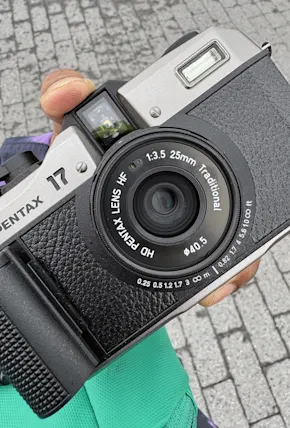
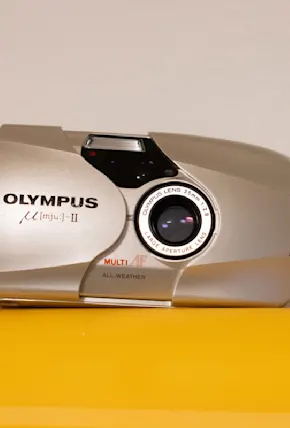
We’re ending our list with a bit of a curveball—this plastic 35mm film camera from Long Weekend (founded by film photog Willem Verbeeck). It’s cheap, fully automatic, and it ain't vintage, so you don’t have worry about it unexpectedly breaking down after one roll like you may with some of the older cameras on this list (plus, you can buy one readily). The lightweight 35mm rangefinder camera features a 31mm fixed focus lens, manual wind and rewind features, and a built-in flash with ~10 second recharge time—all powered by just a single AAA battery (again, unlike the rest of the cameras featured here which largely require a more hard-to-find CR123 battery). You're photos might not turn out with that crispy film look that pulled you down the film rabbit hole in the first place—you'll need to spend a little more for that—but this camera still has the fun of film built-in. It's like a disposable camera, except reusable :)
__
Frequently Asked Questions
What is a point and shoot film camera?
A point-and-shoot film camera is a compact and simple-to-use camera designed for casual photographers. Some point and shoots do feature expert level functionality, premium materials, and even legendary glass, but in general, a typical point and shoot film camera has automatic settings for exposure and focus, designed to allow users to point the camera at a subject and take photos in an instant without needing to adjust many settings manually.
What is the difference between a point and shoot camera and an SLR camera?
The main differences between point and shoot cameras and SLRs are size and portability and lens and viewfinder system. SLR cameras (Single-Lens Reflex) feature an internal mirror that reflects the image the lens “sees” into the viewfinder for the user. Meaning, when you look into the viewfinder of an SLR (or DSLR) camera, you’re actually seeing through the lens.
On the other hand, point and shoot cameras are rangefinders, meaning they do not have an internal mirror but instead a mechanical series of compact lenses and mirrors that approximates what the lens is seeing. Because of this, rangefinders are smaller, quieter, and more compact, but the user doesn't see the same depth of field perception as with an SLR, and accurate framing can be more difficult too.
What is the most expensive point and shoot camera?
The Contax T2 is widely considered the most expensive point and shoot camera. Once found on thrift shop shelves, it’s not uncommon to see a decent condition Contax T2 sell for well north of $1,000. Limited edition Contax T2s can sell for double that. Another icon of Contax make that is considerably less expensive and more adaptable is the G2. Check out our review of the underrated Contax G2 camera to learn all about it.
What is the best 35mm film?
The answer depends on what you're photographing, but for many photographers, the best 35mm film is Kodak Portra 400. It works well in bright to dim light conditions and captures both skin tones and landscapes beautifully. Kodak Gold 200 is slightly more affordable and makes images with a warmer glow that many photogs enjoy—it screams "film!" If you're a traditionalist, you may prefer Tri-X or TMax, a B&W film. Needless to say, I'm a Kodak lover. But Fuji makes some great options too. If you feel like getting artsy, check out Lomography.